Link Copied!

Copy
Linked in

The days of the traditional, linear customer journey are long gone: customers today jump from touchpoint to touchpoint, interacting with your brand in countless ways on countless channels before finally making a purchase.

And crucially, they expect every stage of that journey to feel tailor-made for them, whether they’re browsing your website, scrolling their inbox, or checking their texts.

That’s where a cross-channel marketing strategy adds value. This approach isn’t about bolting on extra channels to blast your customers with, but integrating them into one seamless, connected journey that feels personal - wherever and however they engage. 

Executed well, cross-channel marketing deepens customer engagement, promotes long-term loyalty, and boosts customer lifetime value, whilst also helping teams work more efficiently. 

And with 76% of consumers reporting they feel frustrated when their expectations of personalization aren’t met, the upside for the brands that get it right is huge.

Keep reading to learn the fundamentals of cross-channel marketing, including best practices and campaign examples.
Cross-channel vs multi-channel vs omnichannel: What’s the difference?

Let’s start by clarifying what we mean by cross-channel, and what makes it distinct from multi-channel and omnichannel.


Multi-channel: A strategy which uses multiple channels, but in a siloed way. Each channel is planned, executed, and measured independently, often using separate tools and teams.

Cross-channel: A strategy which integrates different channels and uses them together to guide customers through a journey. Engagement, or lack of engagement, in one channel directly influences what happens in the next.

Omnichannel: A fully unified experience across both digital and in-person channels. Every interaction is informed by the full history of the customer relationship, regardless of where it takes place. It is the aspirational ideal for marketers.

The benefits of cross-channel marketing

Far from just a buzzword, retail brands can realize real benefits from implementing a cross-channel strategy. 

Reduce the risk of over-messaging

A thoughtful cross-channel approach prevents customers from being bombarded with the same message across multiple channels. By coordinating communications and tailoring the frequency to each individual, you can maintain relevance, avoid fatigue, and reduce the risk of unsubscribes or disengagement.

Prioritize channels and control costs

Paid media, SMS, and direct mail are more costly than email or push. A cross-channel strategy allows you to prioritize cheaper channels first and only escalate to more expensive ones when it’s worth the extra spend. This ensures budget is spent where it has the greatest incremental impact.

Re-engage customers who aren’t engaging with email

Email is still one of the most cost-effective channels, but the inbox today is more competitive than ever. Cross-channel marketing gives you alternative ways to reach customers who aren’t engaging with emails, allowing you to re-capture attention while still anchoring your strategy around owned channels.

Deliver consistent, non-contradictory messaging

Siloed campaigns often result in customers receiving conflicting messages or the same offer repeated across channels. Cross-channel orchestration ensures that communications are coordinated, consistent, and relevant to where each customer is in their journey.

Increase brand awareness

Consistent, coordinated messaging across channels helps reinforce brand presence. When customers encounter your brand in multiple contexts with aligned messaging, it strengthens recall and trust without feeling repetitive.

The barriers to cross-channel marketing

There’s no doubt that a cross-channel strategy can hugely benefit your business, but in reality, many retail brands are still hamstrung by their tech stack. Here’s what’s holding them back:

Data silos

The most significant hurdle retail brands face in executing on a cross-channel marketing strategy is siloed data. 

To deliver relevant experiences across channels, brands need a single view of the customer that brings together data from ecommerce, stores, marketing engagement, mobile apps, and every other touchpoint. 

Incomplete customer profiles make it impossible to understand the complete picture of behavior across channels, determine the next best message or channel to contact a customer on, or accurately report on performance. It also limits the impact AI-driven predictive insights and personalization.

Channel fragmentation

Another common barrier to cross-channel marketing is that channels are managed across multiple tools or point solutions. When email, SMS, push, paid media, and reporting all live in separate platforms, coordination becomes complex and time-consuming.

While point solutions may be best-of-breed for individual channels, they create operational friction. Teams find themselves having to manually align campaigns and rely on technical support to maintain multiple integrations, making it harder to deliver a consistent customer experience.

Consolidating channels into a single platform improves both customer experience and efficiency. It enables coordinated journeys, simplifies reporting, reduces costs, and lowers the ongoing burden on technical teams. 

This is where a customer data and experience platform (CDXP) like Ometria, purpose-built for retail use cases, helps brands execute cross-channel marketing more effectively from one place.

The channel landscape

Every channel brings its own strengths, which you can tap into to influence customers at different points in their journey. Here’s a snapshot of the key channels at your disposal and how you might use each one.

Email

Ideal for: Nurturing customers, storytelling, product updates

Email remains the backbone of many retail CRM strategies; it’s cost-effective, flexible, and well suited to longer-form content, storytelling, and engaging customers wherever they are in their journey with your brand.

SMS

Ideal for: Time-sensitive CTAs, reminders, flash sales, new product drops

SMS is already widely adopted in North America and is rapidly gaining traction in EMEA. Its strength lies in immediacy and visibility, making it an excellent choice for timely calls to action that create urgency; however, it’s also more intrusive and more expensive than email.

Push notifications

Ideal for: Time-sensitive CTAs, reminders, flash sales

Though less costly, push notifications are similar to SMS in that they’re ideal for driving a quick action from your app users: Think cart abandonment, price drops, back-in-stock alerts, and personalized reminders. They’re also an excellent choice for transactional alerts, such as an order being dispatched.

Paid social and retargeting

Ideal for: Acquisition, brand awareness, re-engagement

Paid channels such as social and search ads are a key part of any brand’s channel mix, but they must be used wisely. Because they’re more expensive, we recommend using them to activate specific segments such as at-risk or lapsed customers who are not responding to owned channels, or new audiences for brand awareness. 

💡With Ometria, you can laser-focus your targeting by pushing audience segments built in Ometria’s CDP to paid social platforms – instead of relying on third-party data.

Direct mail

Ideal for: VIP engagement, reactivation, loyalty campaigns

Direct mail is typically best reserved for high-value or VIP customers due to its cost. It makes an excellent companion to digital channels, often generating higher response rates due to its physical presence, and can be highly effective for reactivation, loyalty initiatives, or special campaigns.

Cross-channel in practice: Best-practice examples 

Putting a cross-channel strategy into action means knowing when - and how - to bring channels together. The examples below show how leading brands combine channels to nurture and engage audiences throughout the customer lifecycle.

Nurturing leads toward their first purchase

Your welcome series for new subscribers is one of the most powerful levers you have to turn leads into customers.

Naturally, email is the ideal starting point. Use it to tell your story, highlight categories and bestsellers, and surface personalized product recommendations based on their browsing history. 

But for those that don’t convert, try:

  • An SMS or push notification reminding leads of their welcome discount (if you offer one). Couple it with a deadline to deepen the sense of urgency.
  • Re-targeting leads on social with imagery reinforcing your key messaging and hero products.

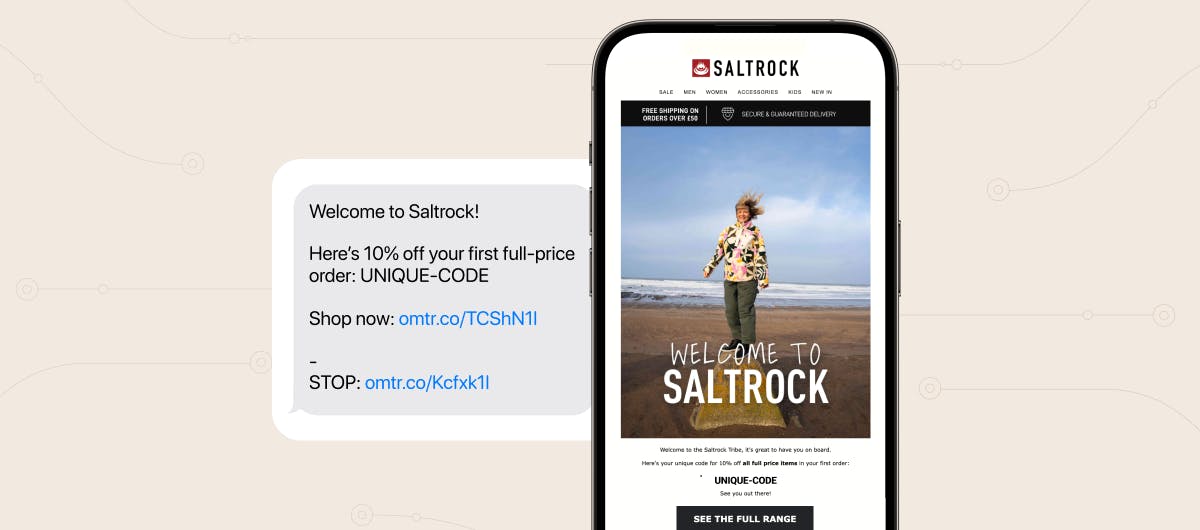
In practice: Saltrock combines email and SMS to strengthen their welcome flow

British lifestyle and surfwear brand, Saltrock, made SMS a powerful part of their welcome series. 

Shortly after receiving the first email in the series, the audience were sent an SMS featuring the same personalized welcome discount code. This timely reminder nudged leads closer to conversion and established SMS as a communication channel from the beginning of the relationship.

Saltrock cross-channel welcome flow

Growing cross-channel subscribers 

Growing your subscriber base across multiple channels gives you more opportunities to build direct, long-term relationships with your customers. The key is to make opting in feel valuable - clearly communicating what subscribers will get, and why it’s worth it.

Early access, exclusive content, or priority notifications help position subscription as a benefit, not a hassle. 

This could look like:

  • Using a WhatsApp channel to notify VIPs of special events, sample sales, or exclusive discounts
  • Gatekeeping your deepest Black Friday offers for SMS subscribers
  • Offering an extra discount or gift-with-purchase when customers make their first purchase through your app

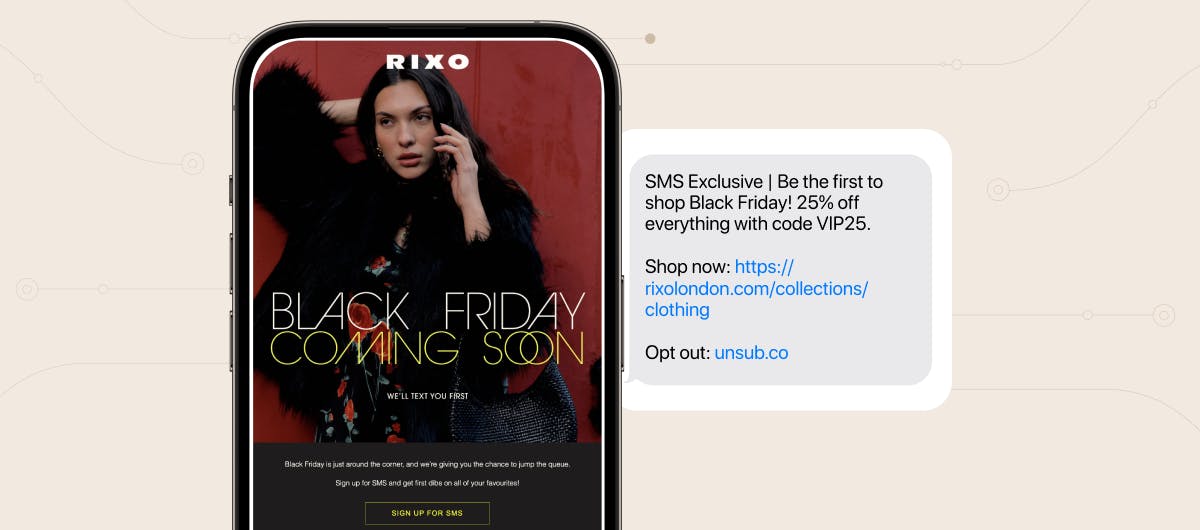
In practice: RIXO leveraged Black Friday to incentivize SMS registrations

Premium London-based womenswear label, RIXO, used Black Friday to grow their SMS list by incentivizing registrations with early access to the sale.

They leaned into personal, insider-style language - “We’ll text you first” - to make subscribers feel part of an exclusive group, reinforcing the value of opting in.

This feeling of exclusivity was then reflected in the SMS messages themselves, as well as driving urgency.

RIXO Black Friday sms + email

Reducing cart abandonment

An abandoned cart is a strong signal of purchase intent, and a cross-channel strategy can help you secure the conversion quickly, before the customer moves on.

Rather than waiting for the customer to check their inbox, consider using more immediate channels like SMS or push notifications to encourage a quicker action, bolstered by language which boosts FOMO and builds urgency (e.g. “x customers recently purchased”, “get it before it’s gone!”). 

If this doesn’t lead to a conversion, follow up with an email that highlights the items left behind and removes friction from completing the purchase. 

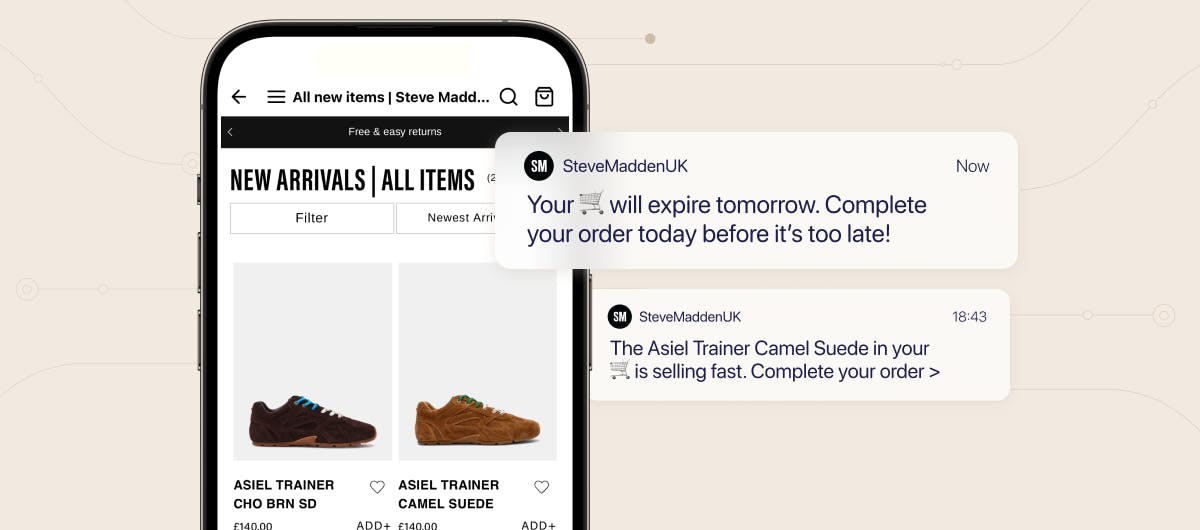
In practice: Steve Madden elevates their abandoned basket flow with push

Iconic footwear and accessories brand, Steve Madden, uses push notifications to capture customers that have abandoned their basket within their app, making sure to build urgency through the message content.

Steve Madden push abandoned basket flow

Grenade used Ometria to orchestrate a truly cross-channel product launch, combining email, SMS, direct mail, overlays, and gamification in automated journeys, with SMS driving 33% of total revenue. Read our case study to learn more about their approach.

Perfecting your cross-channel strategy with AI

Whilst undoubtedly effective, cross-channel strategies can only go so far if they rely solely on static rules and one-size-fits-all decisions. AI changes this by enabling marketers to adapt journeys in real time, ensuring you send the right message, on the right channel, at the right time - every time. 

Here’s how Ometria’s Architect™ AI can support in hyper-personalizing your cross-channel campaigns:

Channel optimization

Architect™ continuously learns from engagement data to determine the channel each customer is most likely to engage and convert to contact each customer on. This insight can then easily be activated in automation campaigns, with the marketer in control, determining whether to use the channel affinity, or decide the channel yourself. 

Send time & frequency optimization

Choosing the right channel is only half the battle, you also need to ensure the message lands at the perfect moment to drive an action from a customer. Architect™ completely removes the guesswork from this process, providing insight into the best time to contact each customer, as well as the optimal number of messages they’d need to receive before converting. 

Predictive Purchase Behaviors

What if you could identify your VIPs, before they became VIPs? Predictive Purchase Behaviors makes it possible. This functionality uses proprietary, retail-specific algorithms to forecast key customer actions, including finding customers that are likely to become high spenders with your brand. By spotting future VIPs early, you can prioritize them for higher-touch initiatives and guide them to VIP status more efficiently.

Final thoughts

Cross-channel marketing is no longer a nice-to-have - it’s a necessity for brands looking to meet modern customer expectations.

With the right foundation in place, cross-channel marketing doesn’t just improve short-term performance. It builds stronger relationships, drives long-term loyalty, and creates a more resilient growth engine for your brand.

Interested in building an industry-leading cross-channel marketing strategy? Why not speak to one of our expert team.

Ometria

“It was really important for us to find not just a platform but a partner that emulated our culture, enabling us to get our campaigns to market with speed and efficiency, while also remaining true to our brand. We can’t wait to move with agility in the coming months while working with true retail experts.”

Abbie Battershill
Digital Marketing Manager
Speak to our expert team about your customer experience growth journey
Join industry leaders in choosing Ometria to power your customer marketing.