Link Copied!

Copy
Linked in

Black Friday 2025 confirmed what leading retailers already know: Black Friday is no longer a day; it’s a season.

Ometria’s analysis of retail performance across the full BFCM window, from November 19th to December 2nd, 2025, shows shoppers spending earlier, staying engaged longer, and behaving very differently from the rest of the year. Below are the Black Friday revenue and marketing performance stats that matter most, and what they mean for planning in 2026.

Once you've read the highlights, check out our annual Black Friday report in full, featuring exclusive data, vertical performance breakdowns, and expert analysis from industry leaders.

Revenue performance

Black Friday delivered a decisive return to growth, with Ometria retailers significantly outperforming broader industry expectations. Shoppers spent more, bought more items per order, and engaged across a wider window than ever before.

  • +14% YoY revenue growth across Ometria retailers (vs. industry forecasts of approximately 1.5 to 4%)
  • +8% increase in orders
  • +5% increase in AOV
  • +8% more items per basket

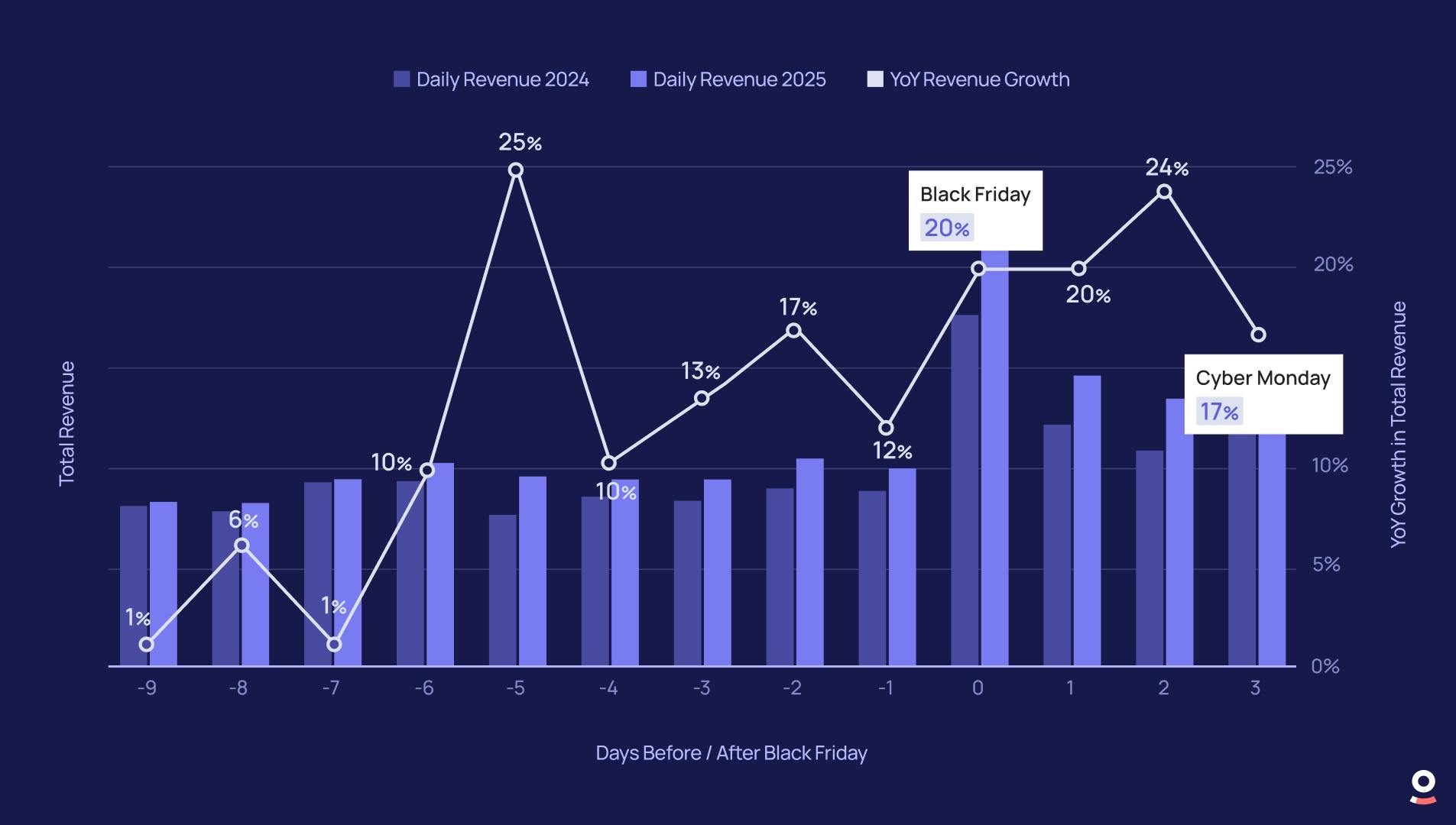
Black Friday itself remained the single biggest revenue day, with average daily spend 121% higher than the nine-day lead-up. However, the shape of the peak continues to evolve. The Saturday after Black Friday overtook Cyber Monday as the second-largest revenue day, growing 20% YoY, while the Sunday before Black Friday posted the fastest growth rate of the entire period (+25% YoY).

YoY Change in Day-by-Day Revenue (Black Friday 2024 vs 2025)

YoY Change in Day-by-Day Revenue (Black Friday 2024 vs 2025)

Top-performing categories:
Gifting (+29%), Sports and Activewear (+27%), Consumer Electronics (+21%), and Luxury Fashion (+18%). Almost every retail vertical recorded positive growth. Download the full report for a complete, category-by-category breakdown.

This extended performance window reflects wider industry trends. Adobe’s annual holiday shopping research has consistently shown that consumer spend is spreading across multiple weeks as promotions start earlier and shoppers become more deliberate in their purchasing.

The takeaway:
The Black Friday sprawl is real. Customers are shopping earlier and staying active longer. Brands that treat BFCM as a two-week narrative rather than a 48-hour scramble are better positioned to capture demand that competitors miss. In 2026, the best campaigns will span the full window, without neglecting the days immediately before and after Black Friday.

Marketing-driven engagement and revenue

Brands sent more messages than ever during BFCM 2025, but volume was not the deciding factor. The real story was what converted.

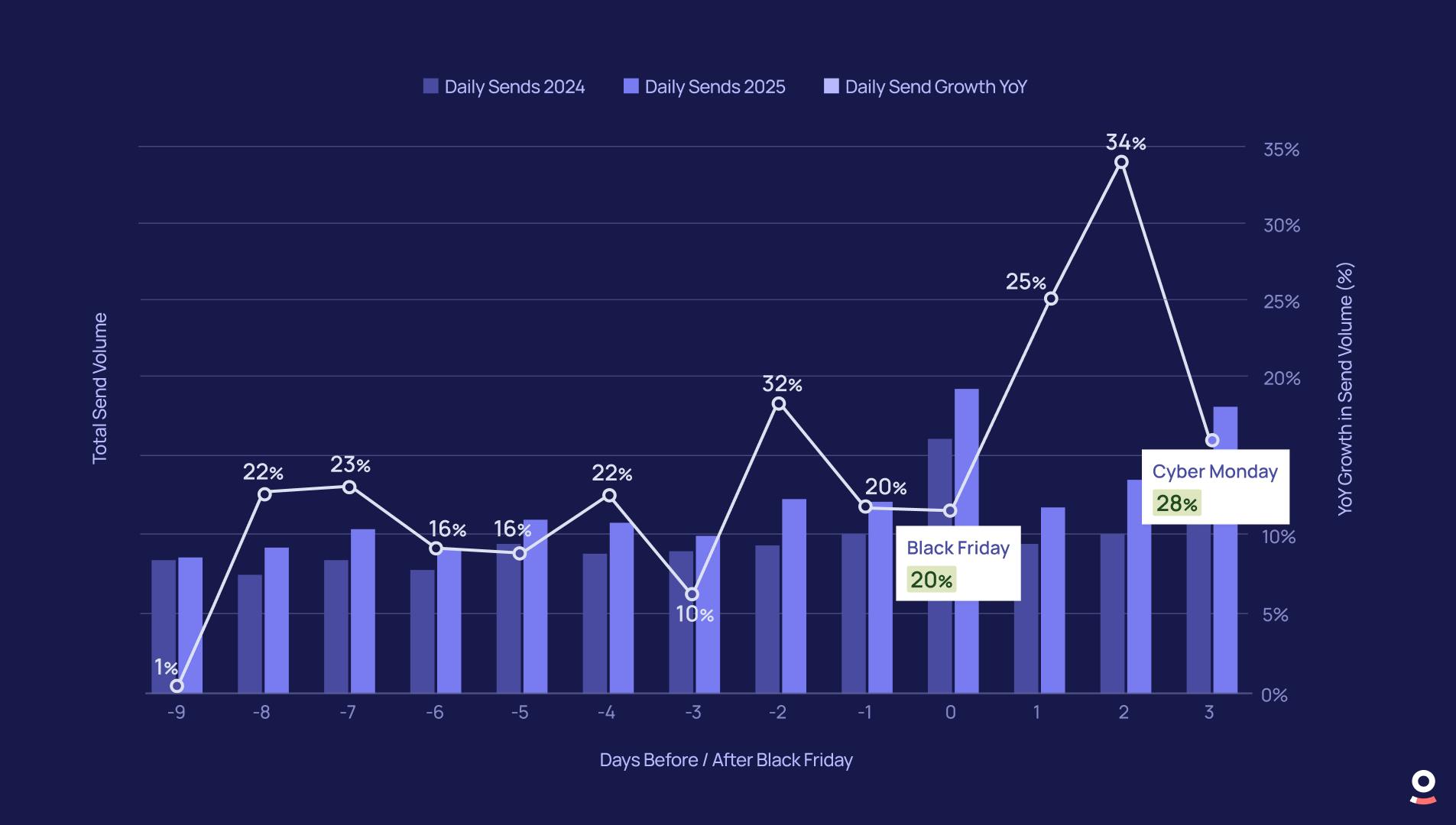
Broadcast campaigns dominated total send volume, while automated programs delivered a disproportionate share of revenue. The strongest performers combined both. High-reach broadcasts were supported by automation designed to convert and retain Black Friday shoppers.

  • +21% increase in total sends across email, SMS, and push notifications YoY
  • Automated emails made up just 2% of sends, but drove 28% of revenue
  • Automated messages delivered 4.6x higher CTR and 8x higher conversion rates than broadcasts
  • Revenue per email increased 13% YoY, despite higher overall send volume
  • Unsubscribe rates rose 42% YoY, though some verticals avoided this trend entirely

YoY Change in Day-by-Day Send Volume (Black Friday 2024 vs 2025)

YoY Change in Day-by-Day Send Volume (Black Friday 2024 vs 2025)

This aligns with broader CRM and lifecycle marketing benchmarks, which consistently show that triggered, behavior-based messaging outperforms batch-and-blast campaigns, particularly during high-intent periods like Black Friday.

The takeaway:
Reach and relevance are not an either or decision. The brands that won BFCM 2025 built a marketing strategy that prioritized both. Personalized broadcasts cut through inbox congestion, while automated flows were built around Black Friday-specific behaviors. For 2026, the opportunity is not to personalize everything. It is to focus personalization where it has the biggest impact. Use your customer data to identify high-opportunity segments and build triggered journeys that turn deal-driven shoppers into profitable customers.

The unsubscribe spike is a clear warning sign. More messages do not automatically mean more engagement. Interestingly, several categories saw lower opt-out rates than their year-round averages. See which verticals were protected in our full report.

Customer loyalty and retention

Black Friday remains one of retail’s most powerful acquisition moments, but retaining those customers is where most brands struggle.

  • 45% of revenue came from new customers, and 55% from existing customers
  • New customer acquisition increased 4% YoY
  • Only 4% of Black Friday 2024 new customers made a repeat purchase within 12 months
  • Of those that made a repeat purchase, 75% made it during Black Friday 2025
  • Black Friday-acquired customers were 6x less likely to return than typical new customers
  • Just 11% of 2024 Black Friday shoppers returned for Black Friday 2025

Repeat behavior varied dramatically by vertical, with some categories seeing nearly 5x higher return rates than others. Get the full category breakdown in the report.

These findings echo broader retail research from the National Retail Federation, which has repeatedly highlighted that while promotions drive acquisition, long-term growth depends on post-purchase engagement and retention.

The takeaway:
Black Friday is an acquisition engine, but retention remains the leakiest part of the funnel. Many peak-period shoppers are deeply discount-driven, and without a dedicated post-purchase strategy, most will wait another 12 months or disappear entirely. For 2026, build onboarding journeys specifically for BFCM cohorts. Drive a second purchase sooner, reinforce value beyond discounts, and give customers a reason to return well before next November.

The bottom line

Black Friday is not just a sales event. It is a stress test for your entire lifecycle strategy.

The brands that treat BFCM as a long-term growth opportunity and act on these signals now, not next November, are the ones that will win the next season.

Data sourced from Ometria’s customer base across fashion, beauty, lifestyle, and specialty retail. For deeper insights, category benchmarks, and actionable recommendations, download the full Black Friday 2025: Unwrapped report.

Frequently Asked Questions About Black Friday Performance

Is Black Friday still the biggest shopping day?

Yes. Black Friday remains the single biggest revenue day for most retailers. However, revenue is now spread across a much longer window, with several surrounding days showing strong growth. Black Friday should be viewed as the peak of a season rather than a one-day event.

When does Black Friday revenue actually peak?

Black Friday itself still delivers the highest daily revenue. In 2025, the Saturday after Black Friday was the second-highest revenue day, while the Sunday before Black Friday showed the fastest year-over-year growth. Retailers that focus only on Black Friday and Cyber Monday risk missing significant demand.

Is Cyber Monday still important compared to Black Friday?

Cyber Monday remains relevant, but its dominance has declined. Many retailers now see stronger performance across the weekend following Black Friday than on Cyber Monday alone, as promotions start earlier and extend longer.

Do Black Friday email campaigns still work?

Yes, but effectiveness depends on relevance. While broadcast volume increased in 2025, automated and behavior-based messages generated a disproportionate share of revenue. The most successful brands paired broad promotional reach with targeted automation.

Why are Black Friday shoppers less likely to be retained?

Black Friday shoppers are highly price-driven and often motivated by one-time discounts. Without a dedicated post-purchase strategy, most new customers do not return. In 2025, only a small percentage of Black Friday-acquired customers made a repeat purchase within 12 months.

How can retailers improve retention after Black Friday?

Retailers should build post-Black Friday onboarding journeys specifically for peak-period customers. This includes encouraging a second purchase soon after Black Friday, highlighting value beyond discounts, and using personalized messaging to build long-term engagement.

How should retailers plan for Black Friday 2026?

Retailers should plan Black Friday as a season, not a single moment. This means spreading campaigns across the full pre- and post-Black Friday window, balancing broadcast reach with automated personalization, and building a clear strategy to retain customers acquired during peak promotions.

Ometria

“It was really important for us to find not just a platform but a partner that emulated our culture, enabling us to get our campaigns to market with speed and efficiency, while also remaining true to our brand. We can’t wait to move with agility in the coming months while working with true retail experts.”

Abbie Battershill
Digital Marketing Manager
Speak to our expert team about your customer experience growth journey
Join industry leaders in choosing Ometria to power your customer marketing.