Link Copied!

Copy
Linked in

Black Friday 2025 was big, with our data showing Ometria retailers growing revenue by 14% year over year, comfortably ahead of the 1.5% to 4% that most industry forecasts had predicted. 

But underneath that headline, a few patterns stood out that should shape how you plan for next year. The shopping window kept stretching, with meaningful revenue landing well before and after the weekend itself. Automation punched well above its weight as far as conversion. And retention remained the hardest part of the season to solve, with only a small fraction of newly acquired shoppers coming back within the year.

For anyone building their 2026 plan, the following breakdown covers the lessons to take from Black Friday 2025, the data behind the trends, and real examples of brands getting it right.
1. Treat Black Friday as a multi-week campaign, not a single weekend

Shoppers have been starting their deal hunting earlier for several years now, and in 2025 retailers clearly responded. Revenue grew meaningfully across the days leading up to and flanking Black Friday, with the Sunday before posting the fastest year-on-year growth of the whole period. 

That said, the day itself has lost none of its pull. Average daily spend on Black Friday was 121% higher than in the nine-day lead-up, so while activity is spreading, the intensity of purchasing still centers firmly on Friday and the surrounding weekend. The task for 2026 is to build a longer campaign that still crescendos where it matters.

Recommendations

  • Map your promotional period as a sequence with a clear build, peak, and wind-down, rather than a single blast of activity around the weekend
  • Use the early weeks for lower-cost engagement plays such as wishlisting and early access sign-ups, saving your heaviest reach and strongest offers for the weekend itself
  • Look back at your own day-by-day performance from last year to see where your peak actually landed, so you can weight your 2026 send schedule and creative drops accordingly. Deep Insights Agent, which connects your Ometria data to Claude, can pull that day-by-day view in minutes, so you’re not waiting on a manual analysis to shape the plan. To learn more, check out our blog on using LLMs to build a stronger Black Friday strategy.

2. Communicate your offers openly

With sales running longer and earlier, price-conscious shoppers are in no rush to take the first deal they see. In 2025, many held out, comparing options and waiting for the right price and timing, which means ambiguity works against you. The brands that made shopping straightforward gave themselves the best chance of capturing that considered spend.

Recommendations

  • Share what will be on sale and when, ahead of time, so shoppers know what to expect and can plan around it
  • Publish a simple sales calendar that helps customers map out their own shopping
  • Signpost shipping cut-offs and return policies clearly wherever they are relevant
  • Auto-apply discount codes at checkout to remove friction at the most important moment

Opting out of Black Friday is a legitimate strategy too, and it can be a strong moment to connect with customers who share your values. ME+EM ran a campaign with the subject line "Why We Don't Do Black Friday," donating to a charity supporting women and girls affected by conflict rather than discounting. For a brand with genuine pricing integrity and a values-led customer base, a position like that can carry more weight than another round of reductions.

3. Reward your loyal customers

Investing in the customers you already have continues to pay off. Existing customers drove 55% of 2025 Black Friday revenue against 45% from new shoppers, closely mirroring the year before, and revenue from this group grew nearly twice as fast. Returning customers also spent more on average. Acquisition remains a genuine revenue driver at peak, but the direction of travel points clearly toward loyalty playing a larger role over time.

Recommendations

  • Identify your VIP and high-value shoppers ahead of the season, then offer perks likely to activate them, such as early or passcode-protected access
  • Consider perks like free delivery or exclusive previews to deepen loyalty without eroding margin
  • Understand what your best buyers actually respond to. Ask Deep Insights Agent which broadcast campaigns generated a disproportionate share of revenue from your highest-value customers, so you can see what content and timing resonate with your best buyers and build more of it into your plan

In practice

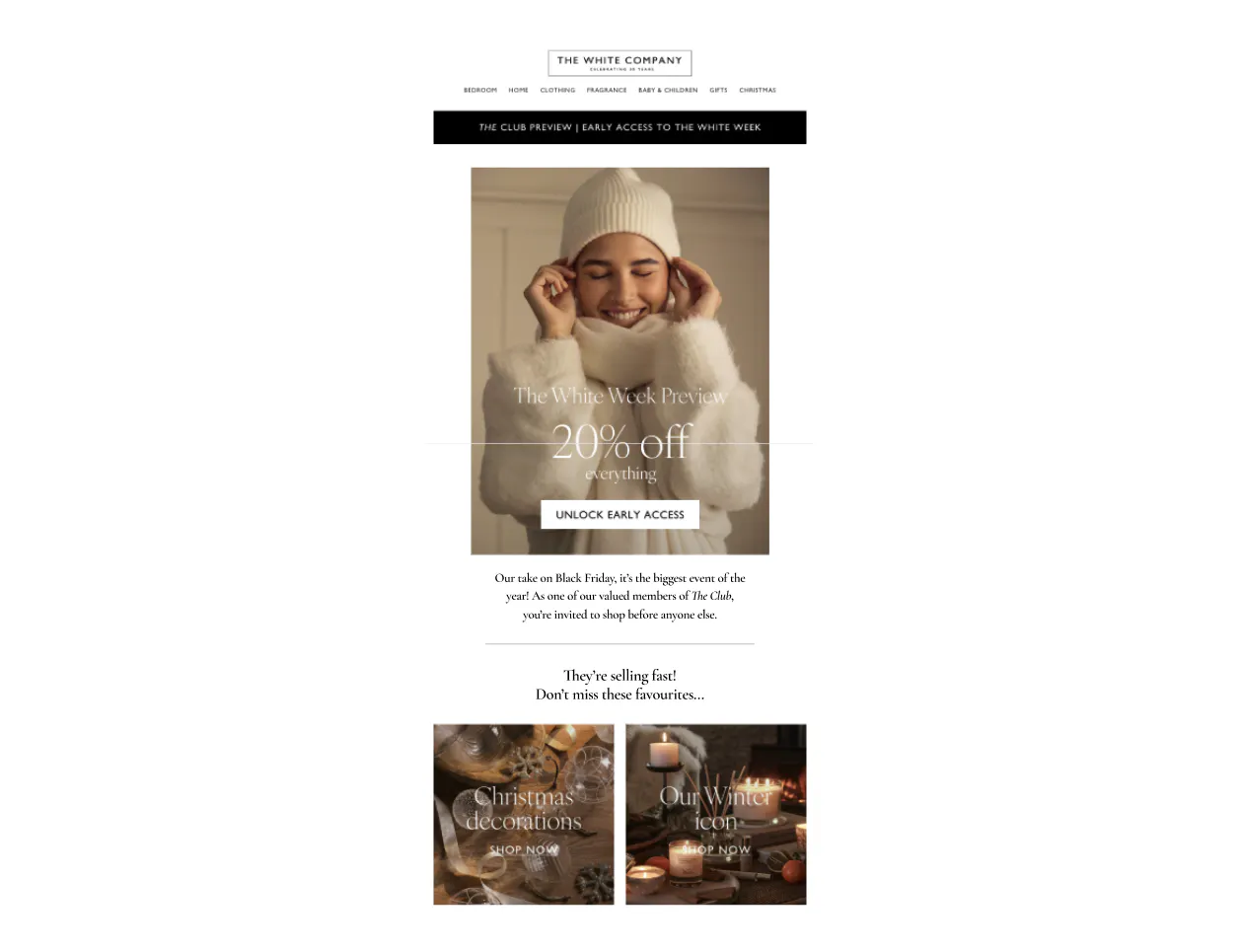
We love how The White Company approached this. Black Friday is usually associated with bargains and urgency, and their brand stands for the opposite, so they rebranded the period as "White Week" and gave members of their loyalty program, The Club, a full week of access before the general sale opened. It's a great example of participating in Black Friday on your own terms while making your most valuable customers feel genuinely rewarded.

4. Use broadcast to drive reach, automation to drive conversion

Broadcast is built for scale, and it does that job well at peak, reaching potential customers en masse when demand is highest. But automation is where a lot of the greatest commercial impact lies: according to our data, triggered, behavior-based messages delivered a 4.6x higher click-through rate and an 8x higher conversion rate than broadcast over Black Friday 2025. 

Reach and relevance are not an either-or decision, and the brands that won last year prioritized both. For 2026, the opportunity is not to personalize everything, but to concentrate personalization where it has the biggest impact.

Recommendations

  • Use your customer data to identify high-opportunity segments, then build triggered journeys that turn deal-driven shoppers into profitable ones
  • Expand your browse, abandon, replenishment, and post-purchase journeys specifically for Black Friday behaviors, rather than relying on year-round flows to carry the load at peak
  • Review which of your automated flows earned their keep last year, and give the underperformers attention before the season starts

5. Think cross-channel

Competition for attention reached new heights in 2025, with total sends across email, SMS, and push growing 21% year over year. In a field that crowded, sending more is not the answer. The brands that stood out built smart cross-channel strategies carefully around what each channel would do, and when. 

Recommendations

  • Look at your owned channels holistically and decide the role each will play, maximizing for cost per message and return rather than pushing the same message through every channel
  • Connect your in-store data with your digital view of the customer, so you can use tactics like geo-targeting to point online shoppers toward their nearest store during the sale

Top tip: Ask Deep Insights Agent to rank every campaign you ran across email, SMS, and push by revenue per message. If your top SMS campaigns are doing the same job as your top emails, you have overlap rather than orchestration, and a clear prompt to define each channel's distinct role for 2026

6. Play the long game

Black Friday brings in new customers at scale, but retention remains the leakiest part of the funnel. Only 4% of customers acquired during Black Friday 2024 made a second purchase in the following 12 months, which makes new Black Friday shoppers six times less likely to return than a typical new customer. Many arrive purely for the discount, and without a dedicated post-purchase strategy, most will wait another year or disappear entirely.

Recommendations

  • Follow up with new Black Friday customers quickly, but not too intensely, since this group cools fast. Welcome journeys, replenishment nudges, and personalized product recommendations all help move them toward a second purchase
  • Build onboarding journeys specifically for your Black Friday cohorts, designed to drive a second purchase sooner and reinforce value beyond the discount
  • Build clear pathways to a second purchase using post-purchase and churn-prevention flows based on the products that first brought customers in, using AI to work out which categories or products they are most likely to have an affinity for

In practice

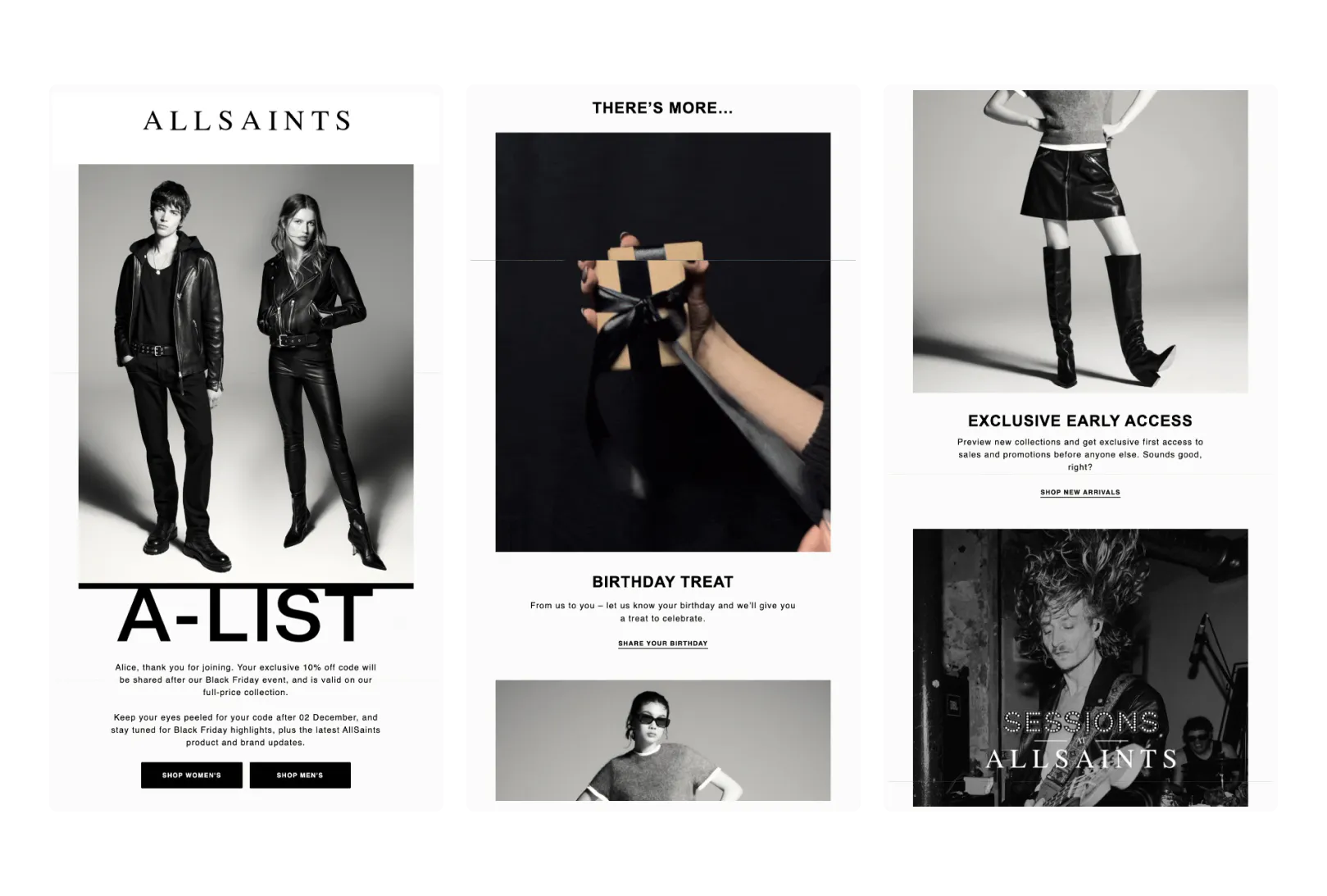
ALLSAINTS built a neat answer to exactly this problem. They created a welcome campaign for customers who made their first purchase during Black Friday, offering 10% off their next order, with the catch that the code only became valid from December 2nd, after the sale had ended, giving first-time shoppers a concrete reason to return quickly. For more campaign inspiration like this, check out our 9 favorite Black Friday campaigns of 2025.

Bringing it together

Black Friday 2025 confirmed that the season is not slowing down. Revenue grew across almost every vertical, engagement held firm through the noise, and both new and existing customers showed up across the full two-week window. 

The retailers who walk into 2026 with real momentum are the ones treating this data as direction: spreading their campaigns while still building toward the weekend, leaning on automation to do more of the converting, planning their channels with intent, and taking the retention gap seriously enough to close it.

Ometria customers, please get in touch with your Customer Success Representative for support with your peak season planning. Not yet with Ometria? Book a demo to explore how you can make Black Friday 2026 your best yet.

Want more Black Friday insights? Check out our Black Friday Content Hub for everything you need to win peak season.

Ometria

“It was really important for us to find not just a platform but a partner that emulated our culture, enabling us to get our campaigns to market with speed and efficiency, while also remaining true to our brand. We can’t wait to move with agility in the coming months while working with true retail experts.”

Abbie Battershill
Digital Marketing Manager
Speak to our expert team about your customer experience growth journey
Join industry leaders in choosing Ometria to power your customer marketing.