
Link Copied!

Copy
Linked in

In retail marketing, the customer experience is everything. Get it right, and you’ll win your customers’ loyalty. Get it wrong, and they’ll quickly go elsewhere: According to BCG, two-thirds of customers have abandoned a brand after experiencing at least one negative personalized interaction. 

Choosing the right platform is crucial to deliver the kinds of experiences customers love to come back to. But often, the MarTech landscape can feel like an impenetrable sea of acronyms: CDP, ESP, CDXP…the list goes on. It’s not always clear how these solutions differ and ultimately which one is right for your business.

In this blog, we’ll cut through the confusion and break down the most common marketing tech stack setups we see in mid-market to enterprise retail businesses. We’ll explore what they offer, where they’re strongest, and which types of teams they’re best suited for.

We’ll cover:

  • Cloud ecosystems
  • Customer engagement platforms and ESPs
  • CDP + point solutions
  • Customer data and experience platforms (CDXPs)
Cloud ecosystems

E.g. Adobe Marketing Cloud, Salesforce Marketing Cloud, and SAP Emarsys

What are cloud ecosystems?

Cloud ecosystems are large, cloud-based software suites that connect marketing with broader business functions such as sales, service, commerce, and analytics.

These ecosystems typically allow teams to:

  • Manage CRM and customer records
  • Run marketing automation
  • Build customer journeys
  • Integrate commerce and service data
  • Analyze performance across the business

They’re usually modular - meaning businesses can license multiple products within the same vendor environment.

What are the strengths of cloud ecosystems?

Built to handle the complexity of large enterprises, these platforms can support multiple business units, regions, and brands without buckling.

  • Consolidation (in theory): If you’re already invested in the wider ecosystem, adding marketing modules can offer consolidation benefits and centralized procurement.
  • Customizability: The modular structure can be highly configurable. Enterprises can build tailored journeys, automation flows, and personalization logic that match complex business processes.
  • Multi-channel execution: Most ecosystems support a wide range of channels (email, SMS, push, etc.) within one vendor environment.

What are the weaknesses of cloud ecosystems?

In practice, cloud ecosystems are often harder to work with than the sales pitch suggests — complex, siloed, and near-impossible for marketing teams to operate independently.

  • Siloed in practice: Cloud ecosystems are more often a patchwork of disconnected modules than the single unified system they’re sold as. Different modules don’t speak to each other in real time, and data syncing delays can limit the effectiveness of behavioral triggers.
  • Reliance on technical teams: These platforms are complex. Marketing teams often depend on IT, data teams, or agencies to build segments, configure integrations, launch new journeys, and adjust logic, slowing time-to-market and reducing marketing autonomy.
  • Generalist, not retail-specialist: Because these vendors serve every vertical, feature development, support, and AI capabilities are broad rather than retail-specific.

Is a cloud ecosystem right for you?

Cloud ecosystems might look tidy from a consolidation perspective, but their inherent complexity mean most marketing teams will end up relying on third parties to get anything done. 

They’re a good choice if: You’re a large enterprise already invested in the ecosystem and you’re comfortable relying on other teams to execute.

They’re not a good fit when: Speed and agility is more your style; you want the autonomy to bring campaigns to market quickly, without having to rely on third parties to get it done.

Musical instrument retailer, Anderton’s Music Co., switched from SAP Emarsys to Ometria’s CDXP because they felt the platform would help them bring campaigns to market much faster.

“Ometria will open up so many exciting new opportunities for us to elevate our customer journey and make every touchpoint with the brand feel personalized and relevant. We've also been impressed with their deep understanding of the retail industry and look forward to working with Ometria to accelerate our growth.” - Felix Avit, Digital Marketing Manager, Anderton’s Music Co. 

Customer engagement platforms and email service providers (ESPs)

E.g. Braze, Klaviyo, Attentive, Voyado, Iterable

What are customer engagement platforms and ESPs?

Built for and usually owned by marketing teams, a customer engagement platform is a cross-channel marketing platform that enables brands to deliver personalized messaging across channels. Similarly, an email service provider (ESP) is a platform that allows businesses to send email campaigns. 

These platforms typically allow marketers to:

  • Build campaigns and automation flows
  • Segment audiences
  • Send email, SMS, and push notifications
  • Track performance
  • Personalize using basic rules and attributes

What are the strengths of customer engagement platforms and ESPs?

Customer engagement platforms and ESPs are built for marketers first: fast to deploy, intuitive to use, and solid for cross-channel campaign execution without needing technical support.

  • Cross-channel focus: They’re strong at campaign orchestration across common marketing channels, allowing teams to build seamless and integrated journeys.
  • Built for marketers: The UI and workflows are designed for marketing teams, meaning building campaigns and segments is straightforward and fast.
  • Quick time-to-value: Basic personalization functionality is built in, enabling teams to deploy campaigns quickly without technical support.

What are the weaknesses of customer engagement platforms and ESPs?

Where they fall short is data — the CDP-like functionality most of them advertise doesn't hold up under scrutiny, which limits how far personalization can actually go.

  • Data limitations: While many claim to include CDP-like functionality, in reality their data capabilities lack the sophistication to drive truly meaningful personalization. Teams often struggle with: No robust native ID resolution, limited support for complex data modeling, and difficulty integrating offline or in-store data
  • Personalization ceilings: Because data depth is limited, marketers can’t trust that personalization - particularly more advanced versions such as AI-powered predictive insights - will be accurate. Scaling brands quickly outgrow what platforms like these can achieve.
  • Generalist approach: Most serve multiple industries, meaning retail-specific use cases may not be deeply supported.

Is a customer engagement platform or ESP right for you?

Customer engagement platforms and ESPs are marketer-friendly platforms which make orchestrating personalized, cross-channel journeys a breeze. But data is usually an afterthought, meaning more advanced personalization remains out of reach.

They’re a good choice if: You’re a small to mid-sized marketing team looking to bring cross-channel campaigns to market quickly and autonomously. 

They’re not a good fit when: You want to personalize in more innovative ways with confidence, leveraging AI-powered capabilities like predictive analytics. 

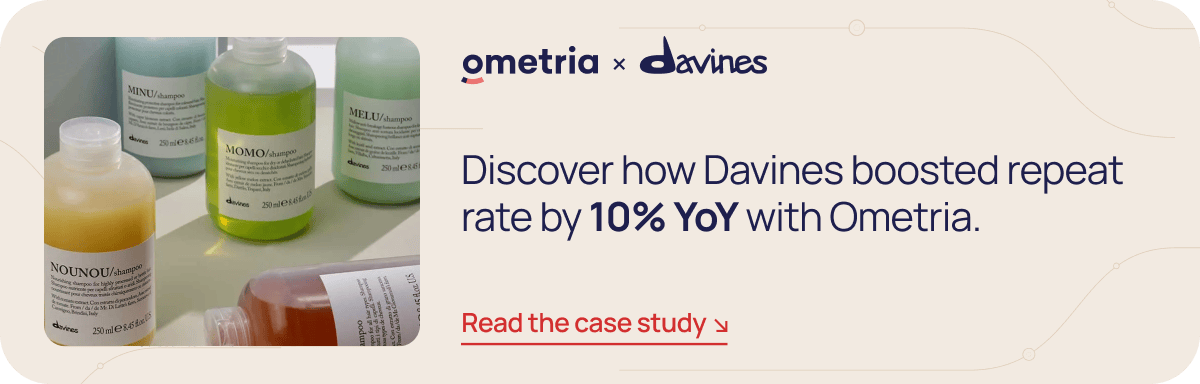
Professional haircare brand, Davines, switched from Klaviyo to Ometria’s CDXP for a platform that could support their scaling business. 

Davines boosted repeat rate by 10% YoY with Ometria

CDP + point solution

E.g. Treasure Data, Amperity, Segment (plus point solutions like Attentive or Klaviyo)

What is a CDP?

A customer data platform (CDP) is a system that collects, unifies, and activates customer data from multiple sources to create a single customer view.

This data layer needs to be combined with a platform to activate that customer data in marketing campaigns. Often, this looks like integrating single-channel point solutions (e.g., email, SMS, push) with your CDP, a setup which combines advanced data capabilities with execution.

Typically, this stack allows teams to:

  • Ingest structured and unstructured data
  • Resolve identities across devices and channels
  • Create advanced audience segments
  • Push those audiences into specialized execution tools

What are the strengths of CDP + point solutions?

This setup gives you the most control: best-in-class data capabilities paired with whichever execution tools fit your channels and workflows.

  • Strong data capabilities: CDPs excel at consolidating many data sources, creating a single customer view with strong ID resolution capabilities and support for custom models.
  • “Best of both worlds”: This set up combines specialized data capabilities with the best-of-breed functionality offered by specialized point solutions, creating a strong and flexible stack you can build to your specific needs.

What are the weaknesses of CDP + point solutions?

However, the flexibility of this set up comes at a cost — CDPs are technically demanding to run, and the integrations holding the stack together require ongoing effort to maintain.

  • High technical requirements: CDPs require significant technical skill to use. You’ll need coding knowledge (or a ticket to your engineering team) to query data, build advanced segments, and maintain integrations. 
  • Disconnected platforms: Success depends on the strength of integration between the CDP and point solutions. When tools are siloed, you’ll need to carry the additional burden of managing the integration, data sync issues can occur, and reporting can end up fragmented. 
  • Need for unified logic: To fully leverage CDPs, consistent semantic definitions and governance are essential. If KPIs are defined differently from tool to tool, you’ll miss the full picture of your data.

Is a CDP + point solution right for you?

CDPs are a powerful tool for unifying your data, and coupling this data layer with your choice of execution tools can feel like a no-brainer. However, marketing teams will need coding knowledge to properly leverage their CDP, or risk becoming reliant on engineering for access. 

They’re a good choice if: You have strong data infrastructure and technical resources, and you’re willing to shoulder the day-to-day upkeep of the integrations in exchange for flexibility and top-of-the-line channel functionality. 

They’re not a good fit when: You’re a leaner team without the technical knowhow to manage a CDP alone, but still want the autonomy to access and action data to build stronger and more personalized campaigns, without relying on IT. 

Customer data and experience platforms (CDXPs)
E.g. Ometria, the only CDXP purpose-built for mid-market and enterprise retail brands. 

What is a CDXP?

A customer data and experience platform (CDXP) combines CDP-level data unification with native cross-channel execution in a single platform.

Because CDPs separated data from execution, marketers became dependent on engineering teams. CDXPs emerged to reunify these layers. In other words, it brings data management and activation together - empowering marketers to access insights and act on them all in one place.

CDXPs typically allow teams to:

  • Ingest and unify omnichannel customer data
  • Build segments using marketer-friendly interfaces
  • Orchestrate journeys across channels
  • Leverage AI for personalization and optimization across the journey
  • Measure performance holistically

What are the strengths of a CDXP?

CDXPs like Ometria close the gap between data and execution in a single platform, giving marketers direct access to unified customer data to build into campaigns, without routing requests through engineering.

  • Marketer-friendly data: Unlike a CDP-based setup, consolidated data and a unified view of the customer is  directly accessible to marketers in a CDXP: no reliance on coding knowledge or other teams.
  • Channel consolidation: All marketing channels are managed in one platform, simplifying orchestration and enabling consistent experiences.
  • Tech stack consolidation: By reducing the number of platforms and integrations required, brands benefit from: Lower total cost of ownership, reduced technical maintenance, and faster campaign deployment
  • AI enablement: Because data and execution sit together, AI has the complete picture, and those insights are easy for marketers to make actionable, not just theoretical. 

What are the weaknesses of a CDXP?

The trade-off is that some specialist use cases sit outside the platform's scope, and the initial data integration work is heavier than most point solutions.

  • Advanced functionality gaps: Some niche or specialist use cases may not be covered (e.g. loyalty scheme; advanced CDP use cases), calling for integrations with third parties. 
  • Weight of implementation: Implementation lift is more significant than a basic point solution due to complexity of data integrations.

Is a CDXP right for you?

CDXPs are a powerful option for retailers looking to combine sophisticated customer data capabilities with true marketing autonomy. By bringing data unification and cross-channel execution together in a single platform, they allow marketing teams to move from insight to action without relying heavily on engineering or external teams.

They’re a good choice if: You’re a scaling mid-market or enterprise retailer managing growing volumes data, with a marketing team that wants direct access to customer insights to inform better personalization and lifecycle marketing. CDXPs are also suited to brands looking to consolidate and reduce integration overhead across your stack, as well as operationalize AI.


They’re not a good fit when: Your marketing operation is still early-stage and focused primarily on single-channel execution (for example, email-only marketing), or you lack the internal data foundations or resources required to support initial data integration and onboarding.

The CDXP: The ideal foundation for AI

AI needs full context to be effective, and the CDXP provides the ideal canvas. 

With a foundation of unified customer, marketing, and commerce data, AI has the insight it needs to predict future behavior and deliver smart recommendations. Combine this with a single platform for cross-channel execution, and AI can act across email, SMS, push, and more, coordinating decisions across the entire journey.

But why is this so important now? In the next 12-24 months, agentic AI will fundamentally change the role of the marketer, automating much of the day-to-day marketing work we know today. It will autonomously manage, monitor and iterate on campaigns, personalize journeys to the individual, and surface insights. 

Marketers will become conductors, setting the strategic and creative vision for AI to execute on - but none of this works without strong data foundations - and the right environment for it to execute within.

Final thoughts

There’s no single “best” MarTech setup - only the one that matches your data maturity, team structure, and growth ambitions.

However, often retailers will reach a point where their existing stack starts to create friction instead of competitive advantage.

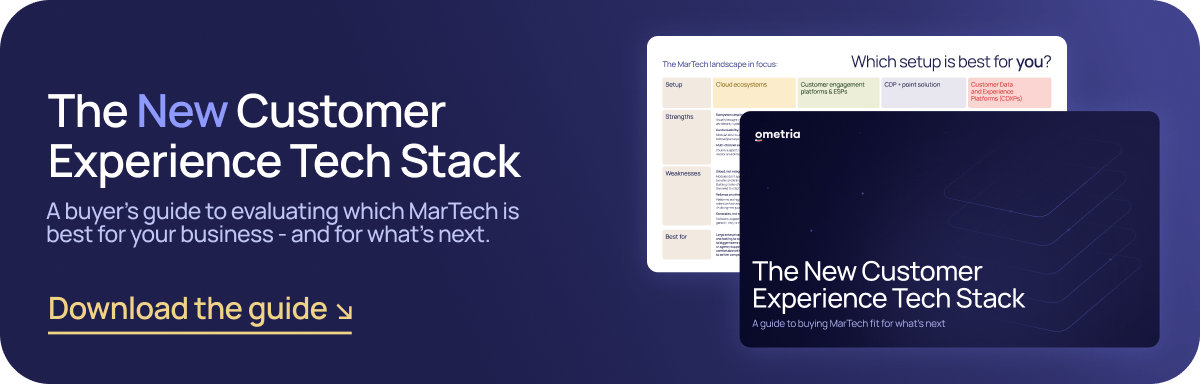
If you’re ready to evaluate your current setup, download our full guide, The New Customer Experience Tech Stack, for a deeper dive.

This guide will help you:

✔️ Identify the gaps in your current MarTech stack

✔️ Evaluate vendors against the criteria that matter most for the customer experience

✔️ Choose a solution that can unlock AI’s full potential

The New Customer Experience Tech Stack

Ometria

“It was really important for us to find not just a platform but a partner that emulated our culture, enabling us to get our campaigns to market with speed and efficiency, while also remaining true to our brand. We can’t wait to move with agility in the coming months while working with true retail experts.”

Abbie Battershill
Digital Marketing Manager
Speak to our expert team about your customer experience growth journey
Join industry leaders in choosing Ometria to power your customer marketing.